Whether at work or during personal lives, good communication skills are essential. They can improve relationships, further a career, and build social confidence. The 7 Cs of communication can help to ensure that communication is as productive and effective as possible across all situations.
The 7 Cs can be applied to all forms of communication, whether that is writing an email, creating marketing content, giving a presentation, having a job interview, or chairing a meeting. Use the 7 Cs of communication checklist below to become a more productive and effective communicator.
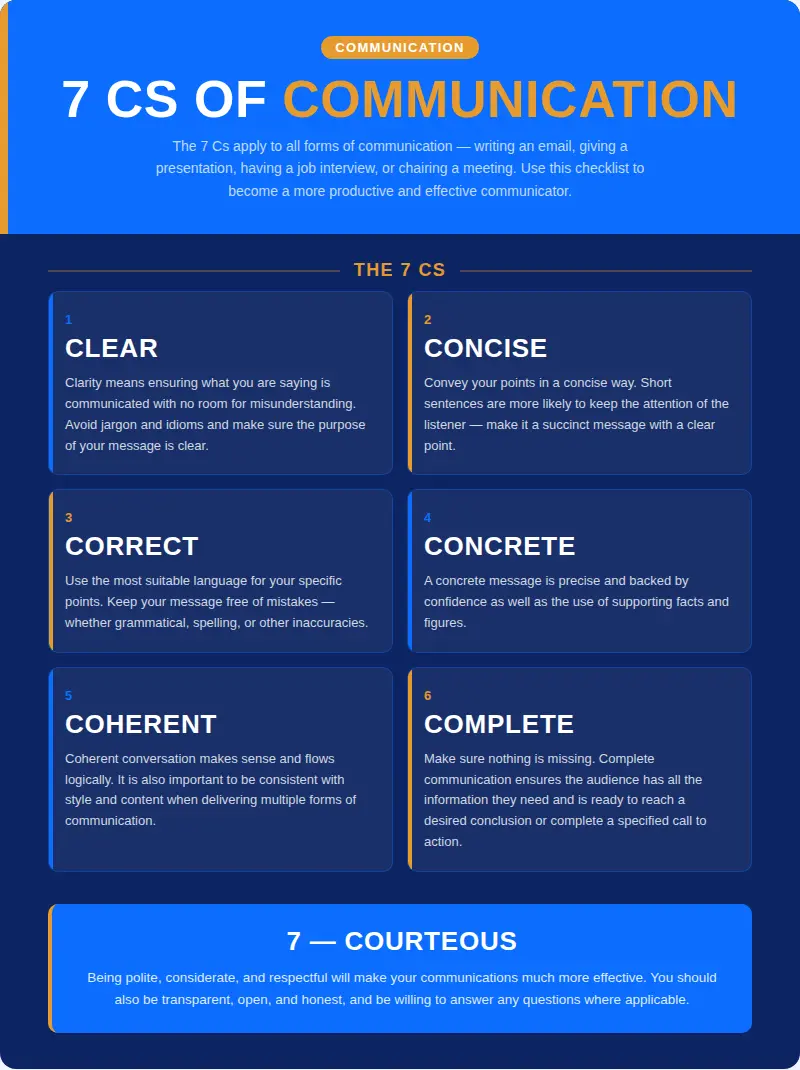
Clear
Clarity means ensuring what you are saying is communicated clearly and with no room for misunderstanding. Good advice for being clear includes:
- Use simple language and focus on the core points of your message
- Do not use idioms, as they can prevent clarity and cause ambiguity
- Be clear in your mind about what you want to say and its purpose before you say it
Concise
Convey your points in a succinct and concise way. Short sentences are more likely to keep the attention of the listener, so use as few words as possible to communicate your message effectively.
Concise communication is non-repetitive, saves time, and is more comprehensible for the audience.
Concrete
A concrete message is precise and backed by confidence as well as the use of supporting facts and figures.
Correct
Use the most suitable language for your specific message and the best form of communication for the context. Correctness also means keeping your language free of mistakes, whether grammatical, spelling, or other inaccuracies.
Coherent
Coherent conversation makes sense and flows logically. Think carefully about the order of your points and how you can make them come across in an easy-to-understand way. It is also important to be consistent with style and content when delivering multiple forms of communication.
Complete
Make sure nothing is missing. Complete communication ensures the audience has all the information they need and is able to easily come to the desired conclusion. Good ways to be complete include:
- Providing a call to action — that is, what you would like your audience to do after receiving the message
- Including hyperlinks in written content to ensure all information is provided
Courteous
It is important to be polite and respectful of your audience. Being friendly, considerate, and professional will make your communications much more effective. You should also be transparent, open, and honest, and be willing to answer any questions where applicable.
The 7 Cs is a versatile tool that can be adapted for use in any form of communication. Developing strong communication skills and confidence is one of the most valuable investments a professional can make at any stage of their career.
How Professional Academy Supports Your Journey
Communication skills are developed and applied throughout Professional Academy's range of accredited qualifications. Whether you are considering a CIM marketing qualification, a management qualification, or a sales qualification, all programmes are designed with practical workplace application at their core.
With study options to suit every professional and course content designed for the workplace, a professional qualification is a proven way to develop your skills and progress your career. To find out more, explore the full range of professional qualifications or book an advice call at a time to suit you.







