For more marketing frameworks and models, visit the Marketing Theories page.
Welcome to the Professional Academy marketing theories series. This entry looks at how marketers use a technique called a stakeholder map, or stakeholder mapping. Marketers use this technique to group all the stakeholders for their organisation into three broad categories: Internal, Connected and External.
To understand this model, it first helps to define what a stakeholder is. In marketing terms, stakeholders are the persons and organisations that have an interest in the strategy of an organisation, and they normally include shareholders, customers, staff and the local community. From this, it is clear that a stakeholder is a person, group of persons, or an organisation that has an interest in, can affect, and can be affected by what the organisation does.
This highlights why organisations need to be able to identify their stakeholders and judge the level of power each holds to affect the decisions and outcomes of the organisation. A first step for any marketer is to create a generic stakeholder map. This map includes all the stakeholders for the organisation, with the organisation at the centre, as shown below.
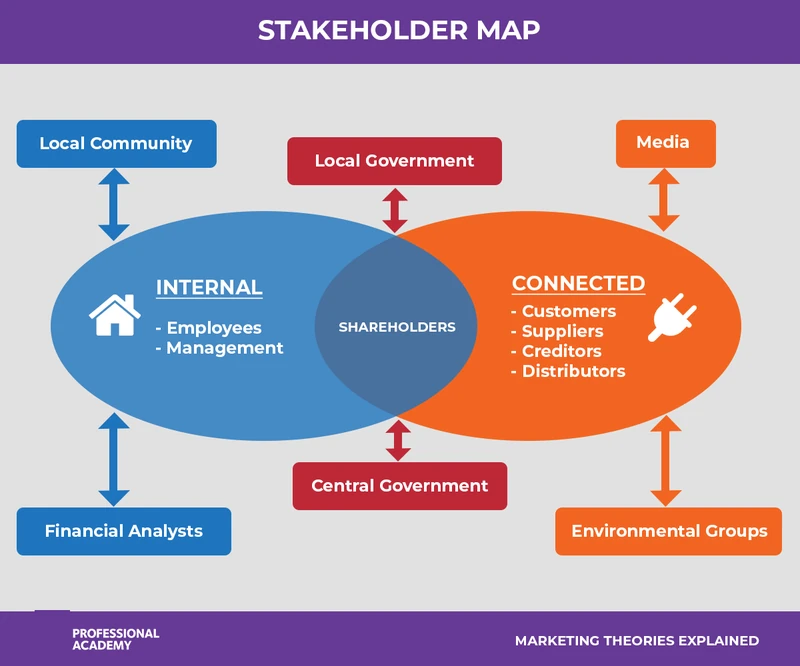
Once this stage of stakeholder mapping is complete, the marketer should have a better understanding of who the stakeholders are for the organisation. This in itself can highlight the impact of certain stakeholders that could have been overlooked in the past. All of these stakeholders can then be placed into one of three broad categories.
Internal Stakeholders
Internal stakeholders are usually members of the organisation. Some examples of who these stakeholders might be include:
- Directors
- Managers
- Employees
Connected Stakeholders
Connected stakeholders, also called primary stakeholders, are those that have an economic or contractual relationship with the organisation. Some examples include:
- Company shareholders
- Customers
- Distributors
External Stakeholders
External stakeholders, also called secondary stakeholders, are those who are not directly connected to the organisation. These stakeholders have an interest in the organisation's activities, or they might be impacted by those activities in some way. Key examples include:
- Governments
- Interest and pressure groups
- Media and news organisations
- Local communities
It has to be said that, while grouping stakeholders into categories is useful, it would be a mistake to think of each stakeholder as an entirely separate entity or group. There is most often overlap between the categories. For example, an organisation's customers are also part of the wider community, and they might also be shareholders or even employees.
The important point to take away from this theory is that any organisation affects the environment it operates in, and at the same time is also affected by that environment. Once all of the organisation's stakeholders have been identified, the next step is to establish the level of power and interest they have in and on the organisation. This is where the Mendelow Matrix can be used to categorise stakeholders further.
Watch Stakeholder Mapping Explained
The video below is part of the Professional Academy Strategic Marketing Theories Explained series, presented by Professional Academy tutor Peter Sumpton, discussing the importance of knowing, grouping and analysing stakeholders.
How Professional Academy Supports Your Journey
Stakeholder mapping is one of many strategic marketing theories taught within the CIM qualifications. Professional Academy has over 27 years of experience helping marketers master these models and apply them in practice. To learn more marketing theory and gain an industry-recognised marketing qualification, explore the CIM marketing qualifications or the Marketing Theories page. If referencing is needed for an assessment, the Harvard Referencing guide can help.







