For more marketing frameworks and models, visit the Marketing Theories page.
Welcome to the Professional Academy marketing theories series. Each entry looks at one of the theories taught as part of the CIM courses. This one examines the widely used SWOT analysis. For those unfamiliar with the theory, SWOT stands for Strengths, Weaknesses, Opportunities and Threats.
The Origins of SWOT Analysis
Many people will have used a SWOT analysis in the past, but few know who developed the theory. Albert Humphrey was an American business and management consultant. During his work at the Stanford Research Institute between 1960 and 1970, he produced a team method for planning named SOFT analysis, which later developed into what is now known as SWOT analysis.
How SWOT Analysis Works
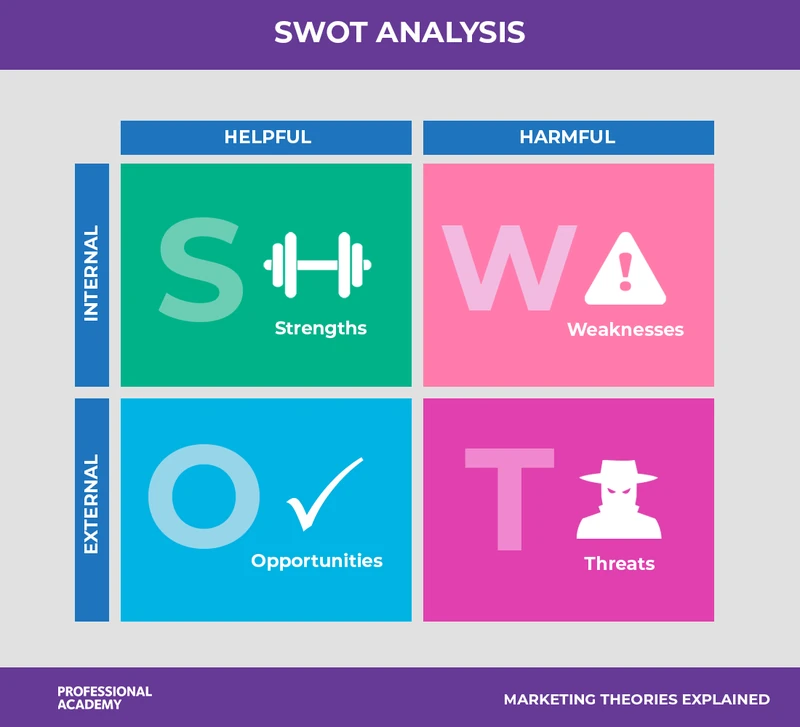
The theory appears simple. A SWOT analysis is used to evaluate the Strengths, Weaknesses, Opportunities and Threats involved in a marketing or business project. The user specifies the objective for the project and then identifies the internal and external factors that will have a positive, as well as a negative, impact on that objective.
It is worth noting that the final objective should be set after completing the SWOT analysis. The reason for this is to ensure that objectives are achievable and not unrealistic, given the current internal and external environments. Every organisation or business has to deal with both internal and external factors that affect it. Users of the SWOT analysis can therefore use the first two sections, Strengths and Weaknesses, to identify internal factors, and the last two sections, Opportunities and Threats, to identify external factors.
When determining each of the sections, it is important that the right questions are asked. A SWOT analysis that does not produce or help towards producing realistic and achievable goals is of little use. The sample questions below are a short selection and will differ from objective to objective and from organisation to organisation. The key point is that the right question helps produce a genuinely valuable SWOT analysis.
Strengths — Internal Factor, Positive Influence
- What are we best at?
- What intellectual property do we own that can help us with this objective?
- What specific skills does the current workforce have that can contribute to this objective?
- What financial resources do we have for reaching this objective?
- What connections and alliances do we have?
- What is our bargaining power with both suppliers and intermediaries?
Weaknesses — Internal Factor, Negative Influence
- What are we worst at doing?
- Is our intellectual property outdated?
- What training does our workforce lack?
- What is our financial position?
- What connections and alliances should we have, but do not?
Opportunities — External Factor, Positive Influence
- What changes in the external environment can we exploit?
- What weaknesses in our competitors can we use to our advantage?
- What new technology might become available to us?
- What new markets might be opening to us?
Threats — External Factor, Negative Influence
- What might our competitors be able to do to hurt us?
- What new legislation might damage our interests?
- What social changes might threaten us?
- How will the economic cycle affect us?
As noted, the lists above are not comprehensive. It is also worth remembering that a threat can sometimes be turned into an opportunity, and a weakness today might be turned into a strength with some effort.
Watch the SWOT Analysis Explained
The video below is part of the Professional Academy Marketing Theories Explained series, presented by Professional Academy tutor Peter Sumpton, outlining how to use the SWOT analysis in practice.
How Professional Academy Supports Your Journey
The SWOT analysis is taught to students on the CIM Certificate in Professional Marketing and is used in the marketing module, together with a PEST or PESTEL analysis, to produce a comprehensive audit of the internal and external environment for an organisation, which learners then apply in their assessment. Professional Academy has over 27 years of experience helping marketers master these theories and apply them in practice. To learn more marketing theories and gain an industry-recognised marketing qualification, explore the CIM Certificate in Professional Marketing, the wider CIM marketing qualifications, or the Marketing Theories page. If referencing is needed for an assessment, the Harvard Referencing guide can help.







