Welcome to another instalment in Professional Academy's series of Marketing Theories Explained. Maslow's Hierarchy of Needs was developed by Abraham Maslow, a specialist in human behavioural psychology. The hierarchy was first developed to help explain the connection between basic human needs and human desires. You can explore more models in the series on the Marketing Theories page.
The hierarchy is often visualised as a pyramid split into five categories. Put simply, unless the fundamental basic human needs at the bottom of the hierarchy are met, a person will not strive to meet any further desires. As each requirement is fulfilled, we move up the hierarchy.
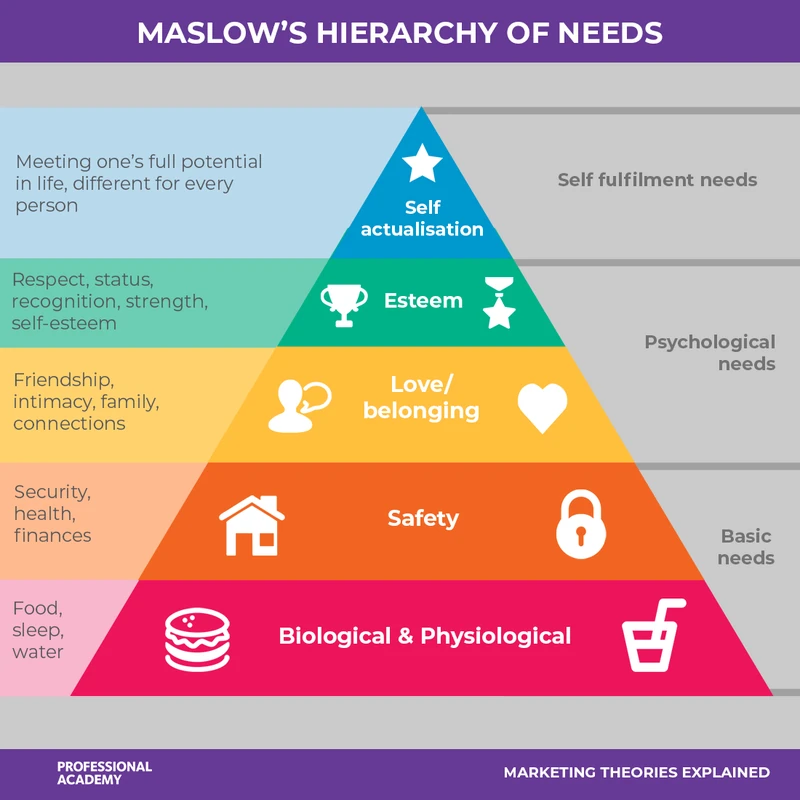
The five levels of the hierarchy
Each level of the pyramid builds on the one below it:
- Physiological needs — the underlying needs humans cannot live without, such as food, water, sleep and oxygen.
- Safety needs — the need to feel safe, whether physically, financially or through job security and health.
- Social needs — the need for social connection through friends and family, and a sense of love and belonging.
- Esteem needs — the desire to have respect and to be respected by others, including self-esteem, confidence and a sense of personal achievement.
- Self-actualisation — realising one's full potential, which differs from person to person. This is the highest level of the hierarchy and what many people strive towards.
Maslow's hierarchy in marketing
When marketers understand the wants and needs of their target market, as every effective marketer should, this understanding can be used as a selling point to influence purchasing decisions. A great deal of research goes into segmenting, targeting and positioning (STP) customers by criteria such as demographics, social class and geography. From this, marketers gain a very specific idea of who their target consumers are and can tailor their marketing strategy accordingly.
For example, a car manufacturer targeting young families is unlikely to focus on top speed and luxury features in its advertising. Instead, it will emphasise cost-effectiveness and safety, appealing to the safety needs that sit near the base of the hierarchy.
It is important to note that a target market's level of needs and desires may not stay the same, particularly in times of political and economic change. It is therefore essential to keep a marketing strategy up to date and relevant.
Learn more with the video series
Professional Academy's YouTube series on how to use marketing theories covers Maslow's Hierarchy of Needs in a short animated video, which you can watch below.
How Professional Academy Supports Your Journey
Understanding consumer psychology through models such as Maslow's Hierarchy of Needs is central to developing marketing expertise. If you would like to develop your marketing strategy knowledge further, the CIM Level 6 Diploma in Professional Marketing is an excellent next step. To find more models in the series, visit the Marketing Theories page, and if you would like help referencing this blog, see the Harvard Referencing blog. To discuss the right qualification for you, the qualification advice team is on hand to help.







