Welcome to the latest instalment in Professional Academy's series of Marketing Theories Explained. The subject of this article is one that anyone working in marketing, sales and marketing will recognise: the Ansoff Matrix. You can explore more models in the series on the Marketing Theories page.
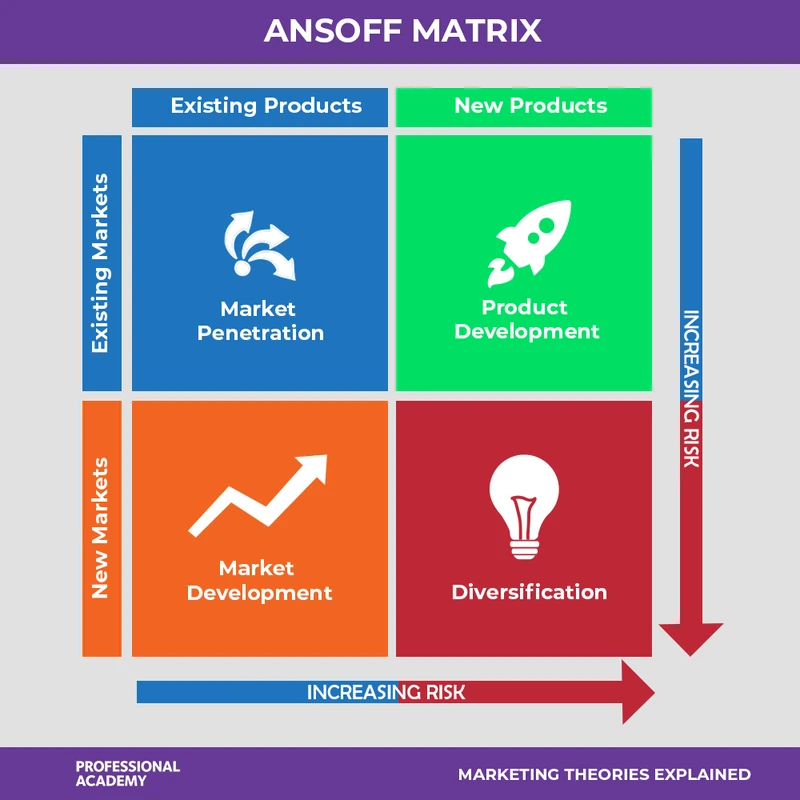
The Ansoff Matrix was developed by Igor Ansoff in 1965 and is used to develop strategic options for businesses. It remains one of the most widely used tools for this type of analysis, largely because of its simplicity and ease of use. As the diagram below demonstrates, the matrix gives managers four possible scenarios, or strategies, for future product and market activity.
Market Penetration
This strategy focuses on increasing the volume of sales of existing products within the organisation's existing market. The key questions it prompts are how the organisation can defend its current market share, and how it can grow its share of that market.
Product Development
This strategy focuses on reaching the existing market with new products. The central question is how the organisation can expand its product portfolio, whether by modifying existing products or creating entirely new ones.
Market Development
This strategy focuses on reaching new markets with existing products from the portfolio. It asks how the organisation can extend its market, for example through new market sectors or by expanding into new geographical areas.
Diversification
This strategy focuses on reaching new markets with new products, and it can be either related or unrelated. In related diversification, the organisation stays within a market it is already familiar with. In unrelated diversification, the organisation moves into a market or industry in which it has no experience, which is considered a high-risk strategy.
Using the matrix in practice
The Ansoff Matrix visualises an organisation's current strategic position and offers four possible routes to take next. It is worth remembering, however, that the framework is not designed to make the decision for you. Instead, it opens up the different strategies available so they can be weighed carefully. The matrix does not take into account external factors such as available resources or risk management, so it is best used as one tool within a larger marketing toolkit.
Learn more with the video series
Professional Academy's Strategic Marketing Theories Explained is a video series that explains marketing models in more detail. The recording for the Ansoff Matrix features CIM tutor and Professional Academy trainer Peter Sumpton discussing how this long-standing model can help you make strategic plans to develop your products and services. For a more visual explanation, the short animated video below outlines how to use the Ansoff Matrix.
How Professional Academy Supports Your Journey
Understanding strategic models such as the Ansoff Matrix is central to developing marketing expertise. If you would like to develop your marketing knowledge further, a CIM marketing qualification is an excellent next step. To find more models in the series, visit the Marketing Theories page, and if you would like help referencing this blog, see the Harvard Referencing blog. To discuss the right qualification for you, the qualification advice team is on hand to help.







