Welcome to another instalment in Professional Academy's series of Marketing Theories Explained. The Balanced Scorecard is a strategy planning and performance management tool created by Kaplan and Norton. In short, it allows managers to see how well their businesses are being run, based on whether the objectives of the company are being met, by monitoring staff and the execution of planned activities. You can explore more models in the series on the Marketing Theories page.
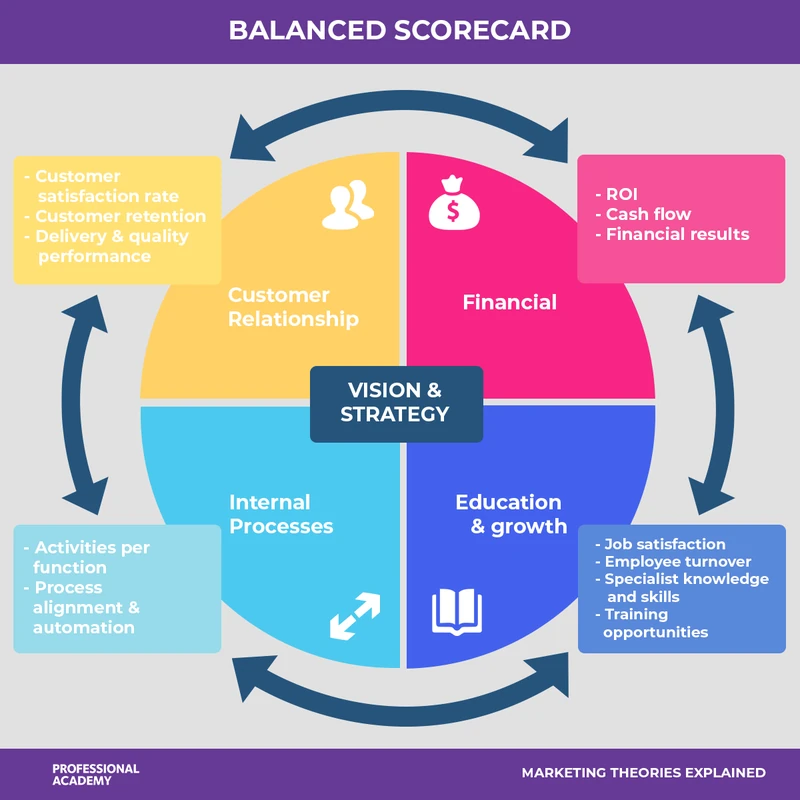
For a business to succeed, it must set objectives in line with the overall mission and vision of the organisation. The Balanced Scorecard suggests that it is not only financial performance that equates to a successful business. It therefore takes the perspectives of four different areas of the organisation and monitors their performance based on their individual objectives. To do this, certain conditions must be in place: objectives must be set, data must be collected, a value must be set to measure the data against, and corrective action must be readily available.
Learning and Growth
The learning and growth perspective asks: to achieve our vision, how will we sustain our ability to change and improve? It involves staff learning and training to improve the organisation's knowledge resource. Managers should be able to identify where they should invest their funds for personnel development, not only through training but through mentoring schemes and by improving communication among staff. Considerations for measurement include job satisfaction, employee turnover, levels of specialist knowledge and skills, and training opportunities.
Internal Business Processes
The internal processes perspective asks: to satisfy our shareholders and customers, what business processes must we excel at? This perspective allows managers to see how well their business is performing based on whether its products and services are meeting the needs of customers. Carefully designed metrics are needed to monitor this area. Considerations for measurement include activities per function, process alignment and process automation.
Customers
The customer perspective asks: to achieve our vision, how should we appear to our customers? In a marketing-oriented business, as opposed to the sales-oriented businesses of the past, customer satisfaction is now increasingly at the forefront of every marketer's, and every business's, mind. Poor performance in this area leads to customers switching to alternative suppliers, and if it is not addressed, a future decline could continue. Considerations for measurement include customer satisfaction rate, customer retention, delivery performance and quality performance.
Financial
The financial perspective asks: to succeed financially, how should we appear to our shareholders? Although the Balanced Scorecard is valuable precisely because it looks at areas beyond finance to judge the performance of a business, this does not mean traditional financial metrics should be ignored, which is why they make up the fourth perspective. Financial metrics remain important for seeing exactly how profitable the business is. Considerations for this perspective include return on investment, cash flow and financial results.
Bringing the perspectives together
By implementing a Balanced Scorecard, a business can work towards improved processes and customer satisfaction, more motivated staff and clear, positive financial results. The tool helps give a balanced overview of a company by measuring it against its own mission and vision. It can be relatively simple to design and implement, as actions are directly matched to the desired outcomes, and it can be used for short, mid and long-term performance measurement.
It is worth noting that there may not be a single scorecard for an entire company. Many organisations use several scorecards, for individual departments for example, which then come together in whatever reporting method the business prefers. This also encourages cross-departmental integrated communication and the sharing of information to benefit everyone.
Learn more with the video series
Professional Academy's strategic marketing video series features an episode on the Balanced Scorecard, presented by marketing professional Peter Sumpton. The video below explains the model in more detail.
How Professional Academy Supports Your Journey
Understanding strategic performance tools such as the Balanced Scorecard is central to developing marketing expertise. If you would like to develop your marketing strategy knowledge further, the CIM Level 6 Diploma in Professional Marketing is an excellent next step. To find more models in the series, visit the Marketing Theories page, and if you would like help referencing this blog, see the Harvard Referencing blog. To discuss the right qualification for you, the qualification advice team is on hand to help.







