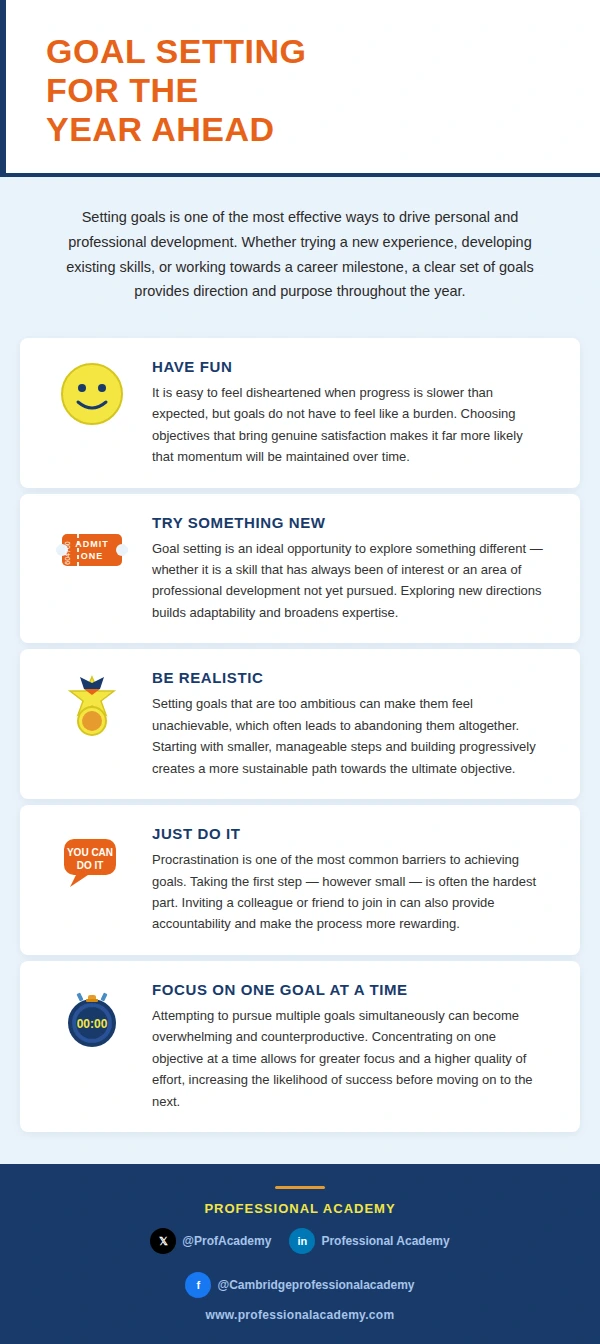
Setting goals is one of the most effective tools for personal and professional development. The infographic below takes the key principles of effective goal setting and presents them in a clear, practical format — from choosing goals that bring genuine enjoyment through to focusing effort on one objective at a time.
Why Goal Setting Matters
Goals give direction to effort that might otherwise be scattered. Without a clear sense of what is being worked towards, it is easy to remain busy without making meaningful progress. Whether the aim is to develop a new professional skill, take on greater responsibility, or move into a different area of work, setting goals creates a framework that turns intentions into outcomes.
Effective goal setting is not simply about writing a list of ambitions. It involves choosing objectives that are realistic, meaningful, and achievable within a defined timeframe — and then committing to the process rather than focusing solely on the end result.
Five Principles of Effective Goal Setting
Have Fun
Goals are far easier to sustain when they are connected to something genuinely enjoyable. Choosing objectives that bring a sense of satisfaction — rather than ones that feel like obligations — makes it significantly more likely that motivation will be maintained over time. Progress does not have to feel like a burden.
Try Something New
Goal setting is an ideal opportunity to pursue something that has previously been put aside — whether a new area of professional knowledge, a creative skill, or an entirely different direction. Exploring unfamiliar territory builds adaptability, broadens expertise, and often opens up possibilities that would not have been considered otherwise.
Be Realistic
Ambitious goals can be motivating, but setting targets that are genuinely unachievable often leads to discouragement. Starting with smaller, manageable steps and building incrementally creates a more sustainable path. Each small achievement reinforces confidence and builds momentum towards the larger objective.
Just Do It
Procrastination is one of the most common obstacles to achieving goals. The longer a start is delayed, the harder it becomes to begin. Taking the first step — even a small one — is often enough to establish the habit of progress. Inviting a colleague or friend to pursue a shared goal can also provide useful accountability.
Focus on One Goal at a Time
Pursuing multiple objectives simultaneously can dilute effort and lead to a sense of being overwhelmed. Concentrating on a single goal allows for greater focus and a higher standard of effort. Once that goal has been achieved or well established, attention can move to the next priority.
Connecting Goals to Professional Development
For professionals looking to make meaningful progress in their career, linking personal goals to a structured qualification programme provides both direction and external accountability. Professional Academy offers a range of qualifications in marketing, sales, and management and leadership — all designed to be studied flexibly alongside existing work commitments.
Further resources on goal setting and personal development are also available on the Professional Academy blog, including guidance on SMART goals and how to approach professional development planning.
How Professional Academy Supports Your Journey
Professional Academy has supported professionals through recognised qualifications for over 27 years. With flexible distance learning options, expert tutor support, and programmes spanning CIM marketing, ISP sales, and CMI management and leadership qualifications, there is a pathway to suit professionals at every career stage. To explore the options available, use the Qualifications Navigator or book a call with the admissions team.







