Extending from the earlier exploration of SMART objectives, SMARTER takes the framework one step further. During research into SMARTER, several versions of the definition for the additional letters E and R emerged — so what is the difference, and what does SMARTER actually stand for?
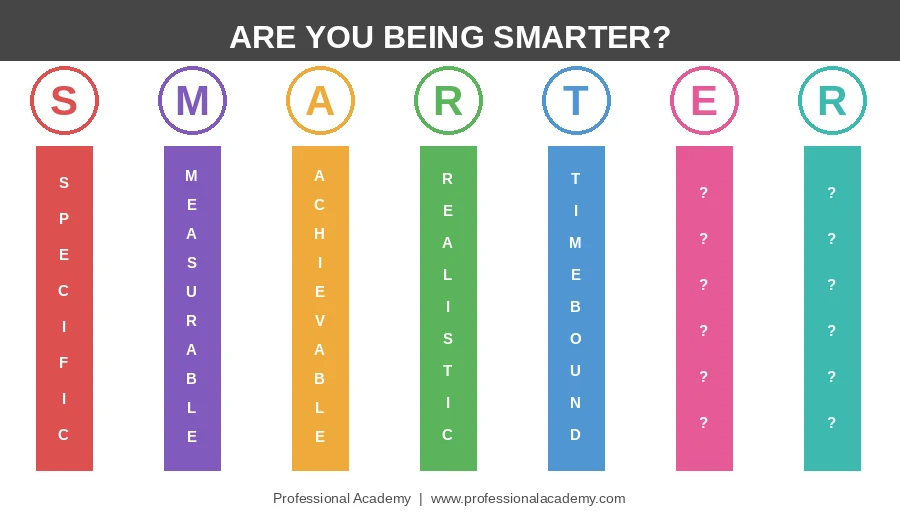
What Is the True Definition of SMARTER
The original five letters of the acronym remain as Specific, Measurable, Achievable, Realistic and Timebound. However, different sources seem to have their own interpretation of what the additional E and R stand for. Some of the variations encountered include:
- Evaluate, Reevaluate
- Evaluate, Review
- Extending, Rewarding
- Ethical, Recorded
- Exciting, Recorded
- Engaging, Recorded
- Ethical, Reachable
- Ethical, Reasonable
Why Has the E Been Added to SMART Objectives
The most common and most reasonable interpretation of the E is Evaluate. This is widely used and makes the most sense — after completing any demanding task, it is valuable to take some time to step back and review what has been accomplished. Building in an evaluation stage encourages reflection and continuous improvement, which is precisely what good objective-setting should support.
Why Has the R Been Added to SMART Objectives
The addition of the R has generated more debate. Among the variations encountered — reevaluate, review, rewarding, recorded, reachable and reasonable — each has a case to be made, though some overlap considerably with what the original SMART framework already covers.
Rewarding is perhaps the most compelling interpretation. When a target has been reached, acknowledging that achievement and rewarding the effort made is a healthy and motivating habit. The reward should, of course, be proportionate to the task — the completion of one assignment does not require a lavish reward, but some form of recognition is beneficial and helps reinforce positive goal-setting behaviour.
Recorded is another interpretation worth considering. Keeping a log of completed objectives helps track progress over time, provides a useful reference for future goal-setting, and makes it easier to demonstrate achievement to others — particularly relevant in a professional or apprenticeship context.
Reachable and Reasonable both mirror the Achievable and Realistic elements already present in the original SMART acronym, which arguably makes them the least useful additions to the framework.
Is SMARTER an Improvement on SMART
Setting a SMARTER objective may be more demanding than setting a standard SMART one. For those looking to adopt the extended framework, using Evaluate and Reward as the E and R offers the most practical and distinct additions to the existing acronym — they introduce new stages rather than duplicating those already present in SMART.
Ultimately, whether SMARTER adds meaningful value depends on how rigorously the original SMART framework is being applied. For those already embedding evaluation and reward into their goal-setting practice, SMARTER simply gives a name to what is already being done well.
How Professional Academy Supports Your Journey
SMART and SMARTER objectives are used across all courses and at all levels in Professional Academy qualifications. Whether looking to study a qualification in management and leadership, marketing, or sales, or as part of an apprenticeship programme, the SMARTER framework will always be a valuable tool.
To find out which qualification is the right fit, use the Qualifications Navigator or book a call with an advisor today.







