What is a SWOT Analysis
A SWOT analysis examines the Strengths, Weaknesses, Opportunities, and Threats your organisation faces. Marketers use this simple planning tool to get a clearer picture of their external and internal environments. SWOT is a useful starting point but on its own does not generate actionable ideas for improvements. That is where a TOWS analysis comes in.
What is a TOWS Analysis
First described by Heinz Weihrich in 1999, TOWS takes a SWOT analysis one step further to help you take action with your findings. The TOWS acronym uses the same elements as its predecessor, but in reverse order. It combines internal and external forces to come up with productive ideas of how best to use the information. The main purpose of a TOWS analysis is to reduce threats, take advantage of opportunities, exploit strengths, and remove weaknesses.
What is the Difference Between SWOT and TOWS
Although TOWS uses the same elements as a SWOT analysis, it is more of an action tool rather than an analysis one. TOWS is best used as an addition to the analytical SWOT tool to help you decide what to do with your findings.
Why is TOWS Important
- TOWS helps bridge the gap between research and forward-thinking strategic directions
- Findings can be presented clearly to organisation stakeholders to gain support
- It can very quickly define key focal points for actions, covering all bases by taking into account positive and negative influences
How Does TOWS Work
First you will need a completed SWOT analysis. If you do not have one, check out our blog post and YouTube video which will help. Your SWOT analysis will have given you a list of Strengths, Weaknesses, Opportunities, and Threats. Number these as S1, S2, W1, W2, and so on. This will make it easier to identify them later.
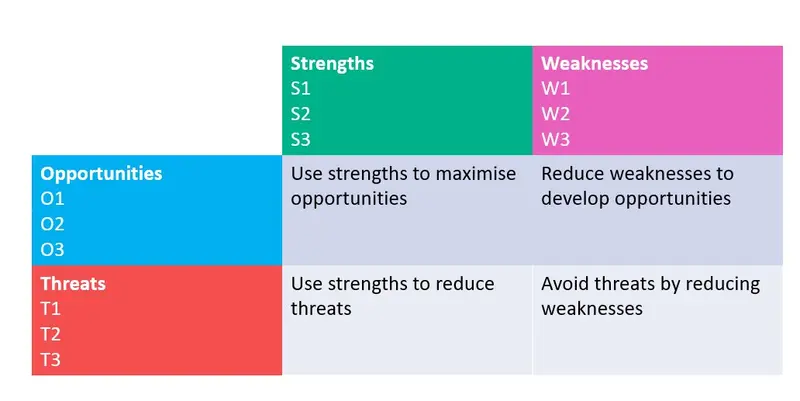
Then, as the diagram above suggests, measure them against each other to consider potential strategies:
- Strengths and Opportunities: Use strengths to maximise opportunities
- Strengths and Threats: Use strengths to reduce threats
- Weaknesses and Opportunities: Reduce weaknesses to develop opportunities
- Weaknesses and Threats: Avoid threats by reducing weaknesses
The following example works through each area using a distribution company's SWOT analysis.
SO: Use Strengths to Maximise Opportunities
- S1 Good distribution network
- O1 Increase market share
Potential strategy: Utilise existing distribution channels to increase availability of products (next day delivery)
ST: Use Strengths to Reduce Threats
- S3 Excellent at co-creating with customers
- T4 Skills gaps within the market
Potential strategy: Integrate co-creation more deeply within the company to bridge the skills gap
WO: Reduce Weaknesses to Develop Opportunities
- W1 No upsell or cross-sell
- O1 Increase market share
Potential strategy: Focus on compatible products and services to complement the existing range
WT: Avoid Threats by Reducing Weaknesses
- W3 Poorly implemented CRM
- T1 Brand awareness is limited
Potential strategy: Focus on reliable data to enhance awareness within the existing market
When you have assessed the relationships above for your own organisation, you should have a matrix similar to the one below.
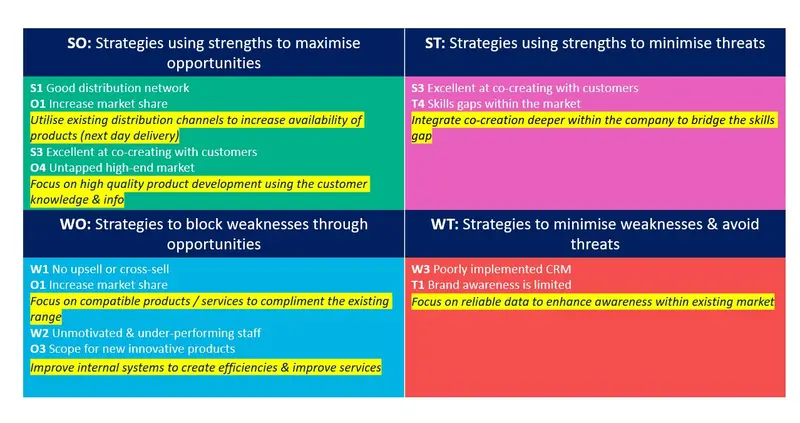
You should now be able to see the benefits of TOWS and how it can expand your SWOT analysis to discover some valuable potential strategies for the future.
Learn More About TOWS
To learn how to carry out a TOWS analysis in more detail, watch the video below from the Strategic Marketing series.
You can also learn more about TOWS and SWOT as well as other strategic marketing tools through the CIM Marketing and Digital Marketing qualifications available at Professional Academy.
How Professional Academy Supports Your Journey
Professional Academy offers a range of accredited CIM marketing qualifications that cover strategic marketing tools including TOWS, SWOT, PESTEL, and more. Programmes include the CIM Level 3 Foundation Certificate in Professional Marketing, the CIM Level 4 Certificate in Professional Marketing, and the CIM Level 6 Diploma in Professional Marketing.
To find out more about which qualification is right for you, get in touch with the team or book an advice call at a time to suit you.







