Among the many tools a manager can use for strategic analysis, scenario planning captures a wide range of possibilities with specific detail. By identifying fundamental trends, a leader can define a series of scenarios that reduce errors in decision-making and provide a sharper approach to the opportunities ahead.
What Is Scenario Planning?
Scenario planning attempts to eliminate the two most common errors in strategic analysis: overprediction and underprediction of an organisation's future. Most organisations make these errors when analysing their strategies. Even when the rate of change is accelerated significantly, the future may not hold what current expectations suggest.
Technological advancement provides a useful reference point. Development in the field of technology continues at a constant rate, yet expectations about what it will deliver have failed in certain areas — a cure for cancer, for instance, remains elusive despite the confidence of scientists and entrepreneurs in earlier generations. The people who predicted those outcomes were working at the frontier of their fields; they simply over-predicted what would be possible within a given timeframe.
Scenario planning draws a line between over and under predictions. It expands the range of opportunities visible to a leadership team while keeping strategy grounded, by segregating knowledge into two areas:
- Things that are known about
- Things that are uncertain
The first category covers things that will almost certainly happen — political cycles, regulatory changes, predictable market shifts. The second covers things that might happen but cannot be confirmed. Scenarios give a view on what can happen in the future, but they do not provide strategies for dealing with those outcomes in isolation. It makes sense to draw on external input — from customers, suppliers, industry analysts, and policymakers — to inform the process.
The overall purpose is to build strategic thinking that encourages variety and provides a sharper approach to the opportunities available.
Scenario Planning: 12 to 18 Months
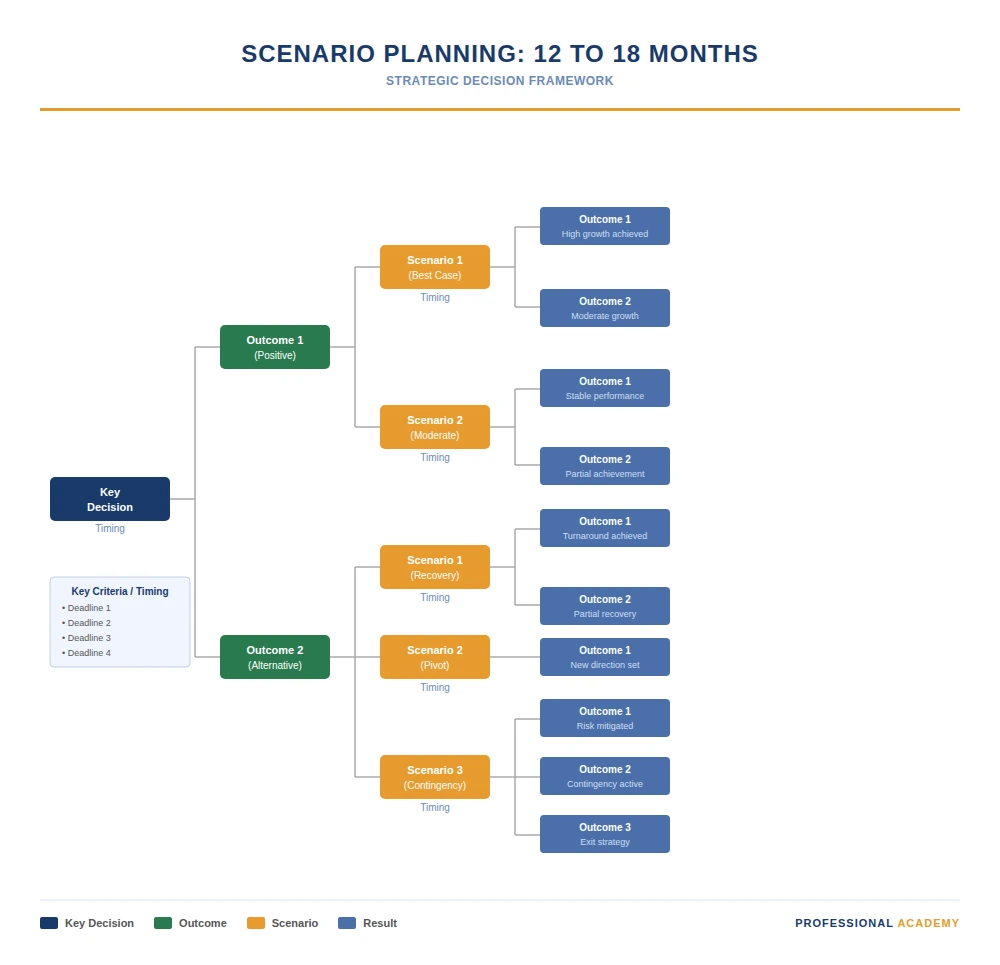
The Scenario Planning Process
Step 1: Brainstorm Future Scenarios
The first step is to decide on a timeframe. When setting the timeframe, several factors should be considered:
- The life cycle of the product or service
- Political conditions and regulatory environment
- Competitor analysis
- Technological advancement
Once an appropriate timeframe has been established, the next task is to determine what knowledge would hold substantial value for the organisation over that extended period. For a decade-long scenario, reviewing the changes that occurred in the department, organisation, industry, region, and broader world over the previous ten years provides a useful baseline for anticipating similar changes ahead.
Step 2: Identify Trends and Driving Forces
When identifying trends and driving forces, the following questions are a useful starting point:
- Who has an interest in these decisions?
- Who will be affected by them?
- Who could influence them?
The driving forces themselves — suppliers, customers, competitors, employees, shareholders, government, and others — should be assessed across several dimensions:
- Their current roles
- Their interests
- Their positions in the field
- Their progress over time
In technical areas, relevant stakeholders may include sector analysts, product specialists, legal professionals, policymakers, and media representatives, among others.
Step 3: Create a Scenario Planning Template
The next step is to identify the driving forces of the environment and document them. These driving forces can originate from the following areas:
- Society and its structure, including demographic, economic, and political factors, and public opinion
- Markets and customer behaviour
- Technology and innovation
- Industry competitive structure
- Organisational capacities and core competencies
The focus should be on separating the forces that are highly predictable from the effects that are less likely to occur. This helps prioritise where scenario planning effort is most valuable.
Step 4: Develop a Scenario
The essential task of scenario planning is developing the actual scenario. A condition needs to be built according to each factor evaluated in the previous steps, creating a situation that reflects the traits and trends of the market. Effective scenario development involves building a clear narrative, identifying the touchpoints around which the scenario will revolve, and then finding the strengths and weaknesses of the plan within that context.
Step 5: Evaluate a Scenario
By following a systematic step-by-step process, the scenario team can achieve a balance between creative thinking and grounded analysis, arriving at sound judgement based on knowledge and experience. The team should consider everything that could potentially affect the issue at hand, including:
- What the energy prices will be
- What the rate of advancement of technology will be
- What the approach of government will be
Step 6: Update Strategies and Policies Accordingly
A month or two after implementing the scenarios, the strategic plan should be evaluated and policies updated according to new market trends. This evaluation and update should be done periodically — market situations change regularly according to the macro-environmental factors identified in the process above. Scenario analysis provides a more explicit picture of the future, determining what is likely to happen based on the experiences of the past.
Scenario Planning Overview
The video below provides a concise overview of the scenario planning process, covering how to identify driving forces, identify critical uncertainties, develop possible scenarios, and discuss implications and strategy.
How Professional Academy Supports Your Journey
Scenario planning is a core strategic management competency and features across Professional Academy's CMI management and leadership qualifications. Whether developing strategic thinking skills for the first time or looking to formalise existing leadership expertise, Professional Academy offers flexible distance learning programmes designed to fit around professional commitments. To find out which qualification is the right next step, use the Qualifications Navigator or book a call with the admissions team.







