Time management is a skill that can be learned and improved at any stage of a career. Whether time feels as though it runs away or tasks pile up without being completed, there are practical techniques that can help. The following time management techniques can be applied to any project, whether at work, in education, or in personal life.
1. Pareto Analysis
This technique is particularly useful when there is a great deal to do in a small amount of time. It is based on the Pareto Principle, which theorises that 80 percent of a project's benefit comes from 20 percent of the work.
It works by listing and identifying problems, then ranking them in order of the largest pay-off. Using this tool, tasks can be grouped in order of effectiveness, helping to prioritise the things that will have the biggest positive outcome.
2. Pomodoro Technique
A well-suited technique for those with shorter attention spans, the Pomodoro technique is a popular tool that breaks up work intervals with small breaks. It creates manageable periods of focused work, which can feel less daunting than working solidly for hours at a time.
For each 25 minutes of focus on a task or project, take a 5-minute break. After four Pomodoros, take a 20 to 30-minute break.

3. Pickle Jar
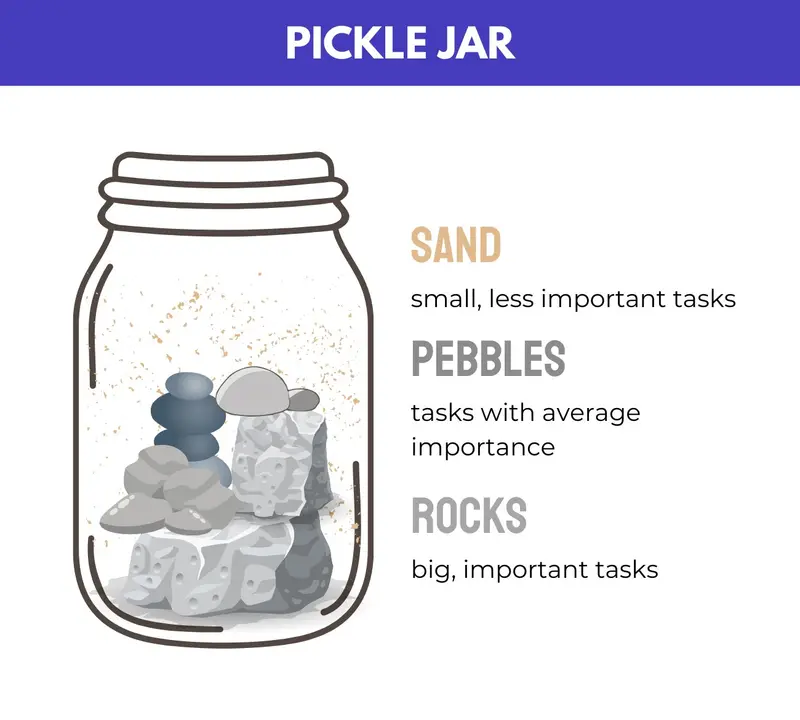
Picture a Pickle Jar that holds all your tasks. The jar represents time. Your tasks are represented by rocks (important tasks), pebbles (tasks of medium importance), and sand (small, less important tasks).
To plan each day, start by adding rocks to your jar, followed by a small number of pebbles, and some sand. The important part is to think about the order and volume of each item. If too much sand is added, there would be no room for rocks — and vice versa. This technique is all about visualising your tasks and making sure you prioritise in the best way. Read more about the Pickle Jar theory.
4. ALPEN Method
Theorised by German economist Lothar J. Seiwert, ALPEN uses an acronym to help you better plan your day. It involves preparing a defined to-do list at the beginning of the day, thinking about how long each task will take, and then setting time slots for each item.
ALPEN stands for:
- Activities: a to-do list of all planned activities, tasks, and meetings
- Length of time: estimations of how long each task will take
- Planning buffer time: adding extra time for interruptions and breaks
- Establishing priorities: considering the urgency of each task and which order they should be completed in, whether they can be delegated, and so on
- Noting level of success: evaluating the day and whether estimations were accurate or need adjusting for future reference

5. Eisenhower Matrix
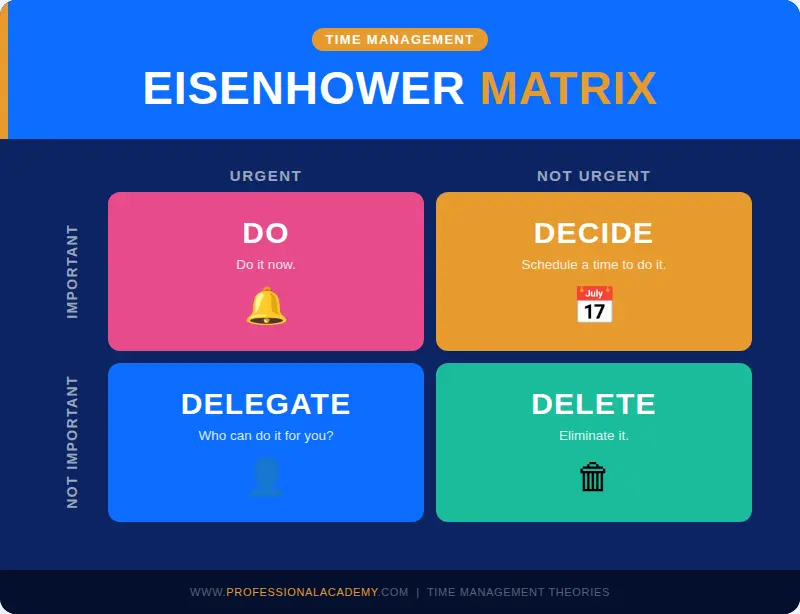
The Eisenhower Matrix recognises the difference between urgent and important tasks and is useful in recalibrating priorities so each area gets the required attention. Inspired by President Dwight D. Eisenhower in 1954, the matrix has since been developed to measure tasks in order of importance and urgency.
Urgent tasks demand immediate attention — because of this, other tasks can be put off or ignored, and longer-term goals and growth opportunities are delayed. The matrix helps to focus on both important and urgent tasks, whilst giving less time to distractions. Read more about the Eisenhower Matrix.
Whether studying or working, these techniques can be invaluable in managing time effectively. Everyone is different and what works for one person may not work for another — it is important to choose the time management tools most suited to your working style and personality.
How Professional Academy Supports Your Journey
Professional Academy offers a range of accredited qualifications in marketing, management, and sales — all designed to fit around a busy professional life. With flexible study options and dedicated tutor support, Professional Academy's programmes are built to help you achieve your career goals.
To find out more about which qualification is right for you, use the Qualifications Navigator, get in touch with the team, or book an advice call at a time to suit you.







