Effective leadership is one of the most studied and debated topics in management, yet when it is observed in practice it tends to come down to a relatively consistent set of qualities. The most effective managers and leaders — regardless of sector, team size, or organisational context — demonstrate certain traits reliably. The following four are among the most important.
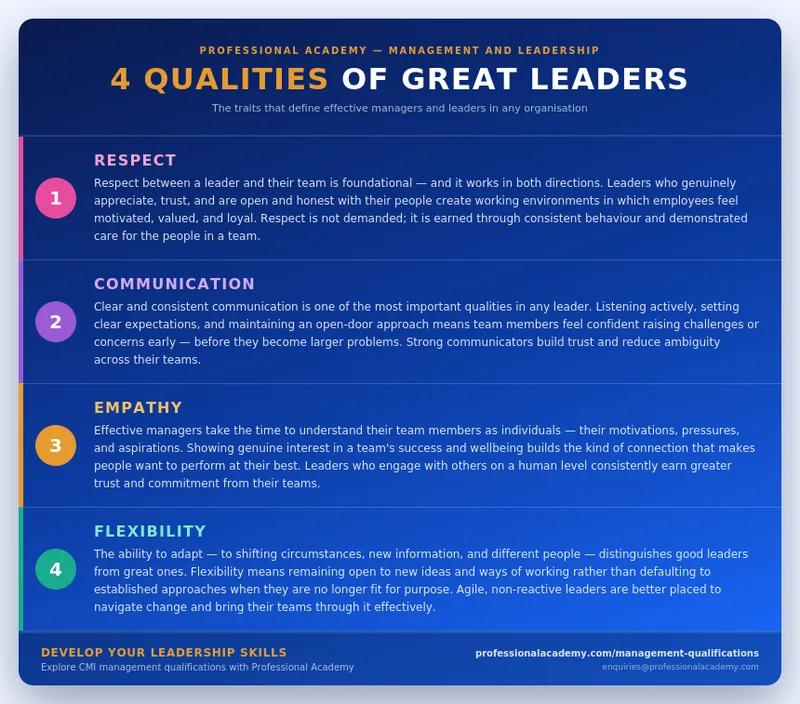
1. Respect
Respect between a leader and their team is foundational to any high-performing working environment — and it operates in both directions. Leaders who demonstrate genuine appreciation for their people, extend trust, and maintain open and honest communication create the conditions in which employees feel valued and motivated to perform at their best.
Respect is not something that can be demanded or assumed as a function of seniority. It is built through consistent behaviour — keeping commitments, acknowledging contributions, being transparent about decisions, and treating each team member with the same consideration regardless of their level or role. Teams that feel respected by their leaders tend to be more engaged, more loyal, and more willing to go beyond the minimum required of them.
2. Communication
Clear and consistent communication is one of the defining qualities of effective leadership. A leader who communicates well does more than convey information — they listen actively, set expectations clearly, provide timely and constructive feedback, and create an environment in which team members feel confident raising concerns or questions without fear of judgement.
Maintaining an accessible, open-door approach means that challenges surface early — when they are still manageable — rather than being suppressed until they become significant problems. Strong communicators also ensure that the purpose behind decisions is understood, not just the decisions themselves. When people understand the reasoning behind what they are being asked to do, they are more likely to engage with it fully and carry it out effectively.
Communication skills become especially important in periods of change or uncertainty, when clarity and reassurance from a leader can make a significant difference to how a team navigates a difficult period.
3. Empathy
Empathy — the ability to understand and genuinely engage with the experiences, motivations, and concerns of other people — is increasingly recognised as a core leadership competency rather than a soft optional quality. Leaders who take the time to understand their team members as individuals, and who demonstrate a genuine interest in their success and wellbeing, consistently earn higher levels of trust, commitment, and discretionary effort from their teams.
Empathetic leadership does not mean avoiding difficult conversations or decisions. It means approaching those conversations with an understanding of how they will land, and with sufficient care for the individual to handle them in a way that is honest but also respectful and constructive. Leaders who connect with their teams on a human level are better placed to identify when someone is struggling, to provide appropriate support, and to retain the talent they have worked to develop.
4. Flexibility
The working environment is constantly changing — in terms of technology, market conditions, team composition, and organisational priorities. Leaders who remain adaptable and open to new approaches are better equipped to navigate this change effectively, rather than defaulting to established ways of working when those approaches are no longer fit for purpose.
Flexibility in leadership means remaining genuinely open to new ideas, different perspectives, and innovative ways of doing things. It means responding to changed circumstances in a measured and considered way rather than reacting impulsively. Agile leaders who model this kind of adaptability tend to build teams that are themselves more resilient and creative — because the culture they create makes it safe to experiment, adapt, and improve.
Flexibility also extends to people management. Different team members are motivated and managed most effectively in different ways, and the best leaders adjust their approach to meet individuals where they are rather than applying a single style uniformly.
How Professional Academy Supports Your Journey
Developing the qualities that define effective leadership — respect, communication, empathy, and flexibility — is a process that benefits from both practical experience and structured learning. Professional Academy's CMI management and leadership qualifications provide a recognised framework for that development, covering the practical aspects of management including planning, managing resources, and leading teams effectively.
Programmes are available from CMI Level 3 through to CMI Level 7, making them suitable for those stepping into management for the first time as well as experienced leaders looking to develop further. Use the Qualifications Navigator to find the right level, or book a call with the Professional Academy team to discuss the options.







