Job hunting is rarely straightforward, but a structured approach and a positive mindset make a significant difference. Whether entering the marketing, sales, or management profession for the first time, returning after a break, or looking to move onwards and upwards within a field, the following strategies will help build a stronger application, raise professional visibility, and make the most of available opportunities.
Find Examples of Your Skills
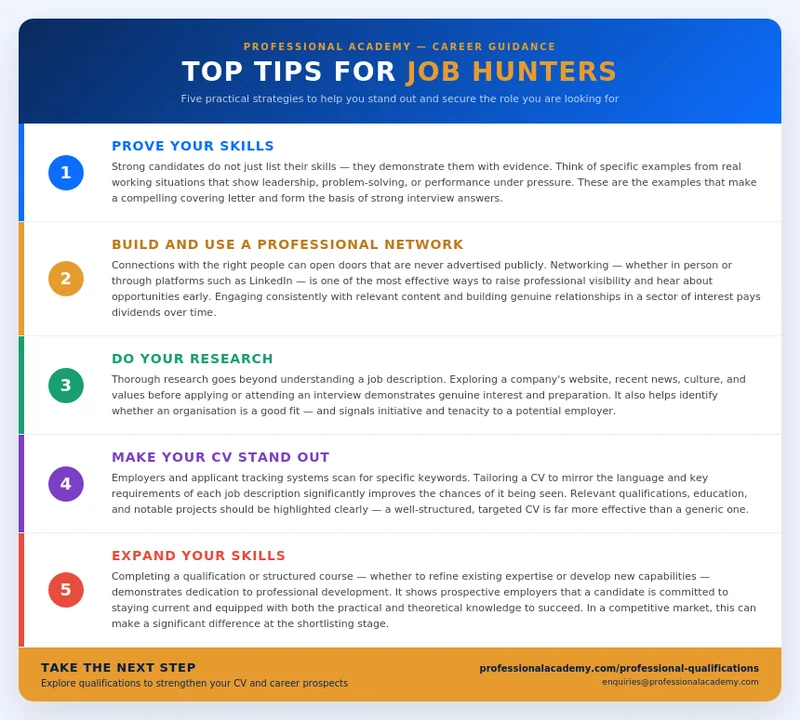
Strong applications and compelling interviews are built on evidence, not assertions. Identifying specific examples from real working situations — demonstrating leadership, performance under pressure, problem-solving, or commercial impact — provides the substance that makes a covering letter and interview answers memorable. The most effective candidates do not simply state their strengths; they illustrate them with concrete, relevant examples drawn from their professional history.
Build a Professional Network
A significant proportion of roles — particularly at more experienced levels — are filled through networks before they are formally advertised. Building and maintaining professional connections increases the chances of hearing about opportunities early and of being recommended for roles that never appear on a job board.
Practical Networking Routes
- LinkedIn — maintaining an up-to-date profile with a professional photograph and actively engaging with industry content
- Volunteering — contributing to relevant projects or organisations builds both skills and connections
- Professional development — studying towards a qualification provides direct access to peers, tutors, and a broader professional community
Do Your Research
Effective research goes beyond understanding a job description. Exploring the websites, culture, values, and recent news of organisations of interest provides useful context for tailoring applications and demonstrates genuine engagement during the interview process. Visiting a company's website directly — rather than relying solely on what appears in a job advert — often reveals information that informs a stronger, more targeted application and signals both initiative and genuine interest to the hiring team.
Establish a Job Search Routine
Treating a job search as a structured activity — rather than an ad hoc one — tends to produce better outcomes. Dedicating consistent time each day to applications, research, and professional development creates momentum and prevents the process from becoming either overwhelming or stagnant.
Planning a Productive Job Search Day
- Set a realistic daily or weekly target for the number of applications to complete
- Use a spreadsheet or task manager to track opportunities, applications, and follow-ups
- Review new job postings consistently and act on relevant ones promptly
- Practise interview technique regularly — mock interviews and reviewing common questions are worthwhile investments of time
- Set aside dedicated time for skills development — attending webinars, completing online learning, and staying current with industry news all strengthen a candidacy over time
- Build in regular breaks — a sustained job search requires consistent effort over a potentially extended period, and maintaining energy and focus is important
Set Clear Goals
Applying widely and indiscriminately rarely produces the best results. A focused search — with a clear sense of the industry, role type, and type of organisation being targeted — tends to generate better quality applications and a clearer personal narrative in interviews. Narrowing the search to a sector or functional area, even without complete certainty on every detail, produces more coherent and compelling applications than a scattered approach.
Focusing the Search
- Search by sector as well as by job title to identify the full range of relevant opportunities
- Check company career pages directly — some roles are not listed on job boards
- Identify the key search terms used in job descriptions in the target sector, such as specific skills, tools, or methodologies
- Consider how career goals align with areas of genuine interest — roles that connect both tend to produce stronger applications and better long-term fit
Make Your CV Stand Out
Many employers use applicant tracking systems that scan CVs for specific keywords before a human reviewer sees them. A CV that does not reflect the language of the job description — even where the underlying experience is strong — risks not making it past the initial filter. Every application benefits from tailoring the CV to mirror the specific requirements and terminology of the role being applied for.
Strengthening a CV
- Keep it concise — a focused, well-structured CV that leads with the most relevant information is more effective than a comprehensive but unfocused one
- Use clean, professional formatting with fonts that are easy to read on screen
- Mirror keywords from the job description — applicant tracking systems look for specific terms, and matching these is a practical first step
- Highlight relevant qualifications, education, and projects that demonstrate capability for the specific role
Expand Your Skills
Completing a qualification or structured course — whether to deepen existing expertise or build capability in a new area — demonstrates commitment to professional development and makes a candidate more competitive at the shortlisting stage. In a market where multiple candidates may have similar experience, a professionally recognised qualification in marketing, sales, or management can be a meaningful differentiator.
How Professional Academy Supports Your Journey
Professional Academy offers a range of professionally recognised qualifications in marketing, sales, and management and leadership, designed to fit around the demands of working life. Programmes are available at multiple levels, from introductory certificates through to postgraduate qualifications, and are delivered through blended learning with dedicated tutor support.
Use the Qualifications Navigator to find the right starting point, or book a call with the Professional Academy team to discuss the options.







