
If you budget for training, 2026 has changed the arithmetic. The Apprenticeship Levy has been renamed the Growth and Skills Levy, the window for spending your funds has halved, and the amount levy-paying employers contribute once those funds run out has risen fivefold. At the same time, the cash incentives for taking on an apprentice have grown, and one of them opened on 1 October. This guide explains what the levy is, what changed this year, what you can claim on top, and what it all means for your training budget — whether or not you pay into the levy.
What the Growth and Skills Levy Is
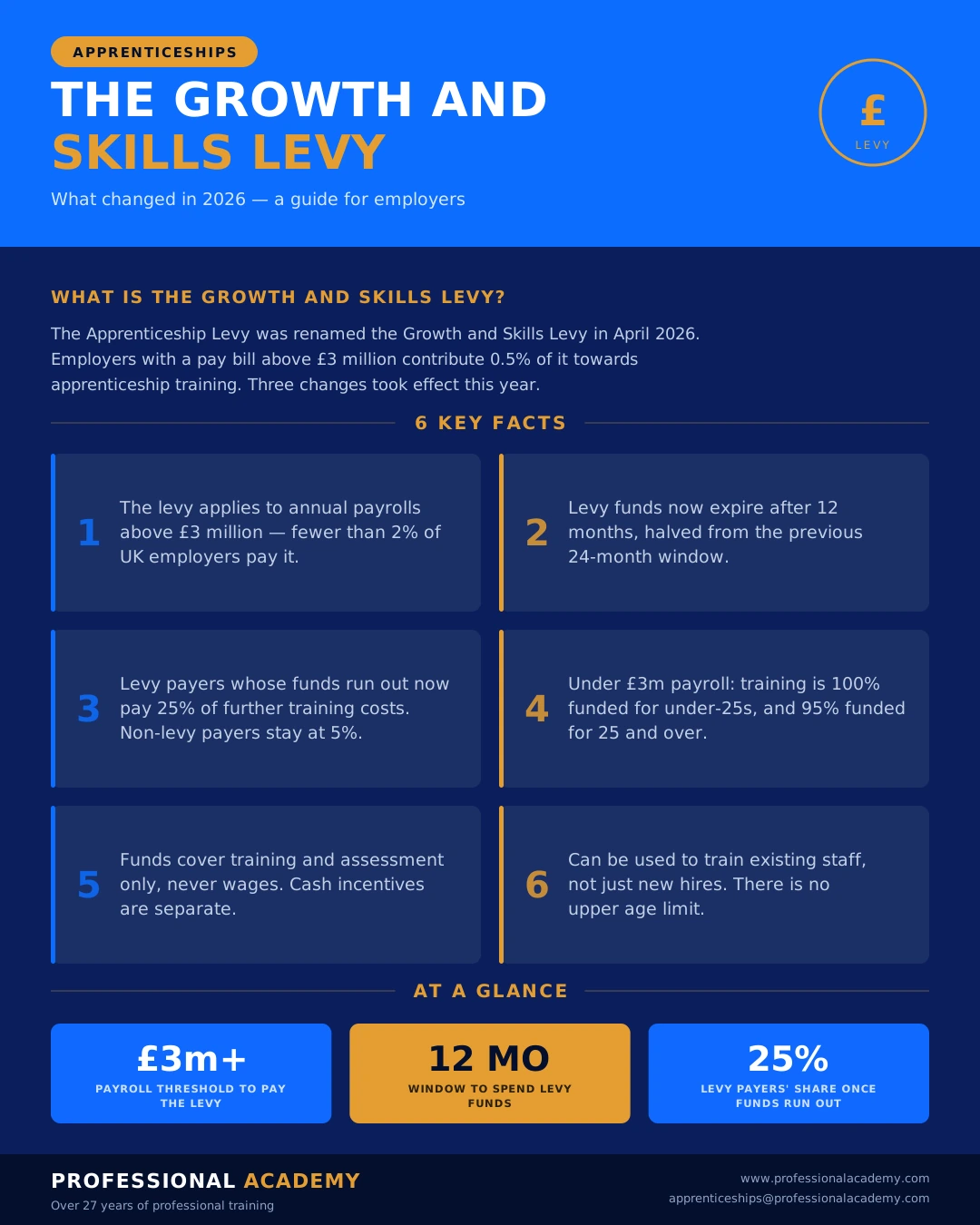
The levy is a payroll charge on larger employers, introduced in April 2017 as the Apprenticeship Levy and renamed the Growth and Skills Levy in April 2026.
If your annual pay bill is more than £3 million, you pay 0.5% of it into the levy through PAYE. Every employer gets a £15,000 annual allowance to offset against that charge, which is why the £3 million threshold works out as the practical starting point. The money you pay in appears in a digital apprenticeship service account, and you draw on it to pay for apprenticeship training and end-point assessment.
The important point, and the one most often missed: levy funds pay for training and assessment only. They cannot be used for apprentice salaries, recruitment costs, travel, equipment or your own staff's time supervising the apprentice. Those remain your costs.
What Changed in 2026
Three changes to the levy took effect in August 2026, and a fourth change to Level 7 funding landed in January. Together they shorten your planning window and increase what you pay.
Funds now expire after 12 months, not 24
Levy funds used to sit in your account for 24 months before expiring on a rolling basis. That window is now 12 months. If you have historically let funds accumulate and spent them in the second year, that approach no longer works — unspent money returns to the Treasury twice as fast.
Co-investment has risen from 5% to 25% — for levy payers only
Once a levy-paying employer has exhausted the funds in their account, they move onto co-investment: the government pays a share of further training costs and the employer pays the rest. The employer share was 5%. It is now 25%.
For an apprenticeship with a funding band of £8,000, that is the difference between contributing £400 and contributing £2,000. If you run a programme large enough to spend past your levy pot, this needs to be in next year's budget rather than discovered mid-year.
This change does not affect employers who do not pay the levy. If your pay bill is under £3 million, your contribution is unchanged — and for younger apprentices it has improved. See the section below.
The 10% government top-up has been removed
The government used to add 10% to the funds entering your account each month. That top-up has gone. You now access the value of your own contributions and nothing more.
Level 7 apprenticeships are no longer funded for most learners
From January 2026, public funding for Level 7 (master's-level) apprenticeships was removed for anyone aged 22 or over. Funding continues for apprentices up to age 22, and up to age 25 for care leavers and those with an education, health and care plan. Apprentices who started before January 2026 continue to be funded to completion.
If you had planned to use levy funds for senior-level apprenticeship training, this is the change most likely to affect you. Note that it applies to the apprenticeship route only — professional qualifications at the equivalent level, such as the CIM Level 7 Marketing Leadership Programme, are unaffected and can still be employer-funded directly.
If You Don't Pay the Levy
Employers with a pay bill under £3 million do not pay the levy, but can still access government funding for apprenticeship training through the same apprenticeship service.
Since April 2026, the government covers 100% of training and assessment costs for apprentices aged under 25 at employers that do not pay the levy. There is no employer contribution at all. For apprentices aged 25 and over, the government covers 95% and the employer pays 5%.
For a smaller business, this is the most generous the arrangement has been. A Level 3 or Level 4 apprentice under 25 can now be trained at no training cost to you.
Cash Incentives on Top of the Funding
Everything above concerns who pays for the training. Separately, there are cash payments for employers who take on an apprentice, and this is the part most often missed. Where more than one applies to the same hire, they can be combined — up to a total of £8,000.
£1,000 for apprentices aged 16 to 18
Available to all employers, levy-paying or not, for an apprentice aged 16 to 18. It also covers apprentices under 25 who have an education, health and care plan or are care leavers. Usefully, this one applies to existing employees starting an apprenticeship, not only new hires. Paid in two £500 instalments.
£2,000 for smaller employers hiring an apprentice aged 16 to 24
New from 1 October 2026 and available to employers who do not pay the levy. It applies to a new apprentice aged 16 to 24 who joined you shortly before their apprenticeship started. Paid in two £1,000 instalments.
Note the distinction: this one is for new recruits. If you are putting an existing member of staff through an apprenticeship, this payment does not apply, though the £1,000 above may.
£3,000 Youth Jobs Grant
Open to any employer taking on someone aged 18 to 24 who has been claiming Universal Credit and looking for work for six months or more. The role must be at least 25 hours a week and expected to last at least four months. Available since 30 June 2026 and paid as £1,800 in month two and £1,200 in month five.
This one sits outside the apprenticeship system entirely — you claim it yourself through the government's Find a Grant service rather than through your training provider.
When the money actually arrives
This is where expectations most often come unstuck. The apprenticeship incentive payments are not paid on day one. They are paid in instalments, the first of which is typically released around three months after the apprenticeship starts and the second at around twelve months, and they usually reach you via your training provider rather than directly. Budget for the hire on the assumption that the cash follows later in the year.
What This Means for Your Planning
Three practical conclusions follow from the 2026 changes.
- Check your account balance and expiry dates now. With a 12-month window, funds you assumed you had time to use may be closer to expiring than you think.
- If you pay the levy, build the 25% into next year's budget where your apprenticeship spend is likely to exceed what you pay in. Being surprised by this mid-year is the most common way organisations end up pausing a programme.
- Plan starts across the year rather than in one intake. Spreading enrolments smooths the draw on your account and keeps funds moving before they expire.
You can model the cost of a specific programme using our apprenticeship business case calculator, which sets training cost against the productivity and retention case.
Apprenticeships Are Not Only for New Recruits
A persistent misconception is that an apprenticeship means hiring someone young and new. It does not. An apprenticeship is a training programme, and existing employees can be enrolled on one provided the training develops substantial new skills relevant to their role. There is no upper age limit.
In practice this means you can use levy funds to put a marketing assistant through a structured development programme, or to formalise the skills of a sales team that learned on the job. For many employers that is the single most valuable use of the account.
Apprenticeships at Professional Academy
We deliver apprenticeships in marketing, sales and business administration, and we are an Ofsted-inspected provider.
- Marketing apprenticeships — Multi-Channel Marketer (Level 3), Marketing Executive (Level 4) and Marketing Manager (Level 6), several of which carry a CIM qualification alongside the apprenticeship.
- Sales apprenticeships — Sales Executive (Level 4), delivered with the Institute of Sales Professionals.
- Business administration apprenticeships — Business Administrator (Level 3).
For a fuller picture of how a programme runs, see our guide for employers and organisations and the detail on apprenticeship funding.
Frequently Asked Questions
What is the Growth and Skills Levy?
It is the renamed Apprenticeship Levy, a 0.5% charge on the pay bill of employers with an annual payroll above £3 million. The funds are held in a digital account and can be spent on apprenticeship training and end-point assessment. The name changed in April 2026.
How long do levy funds last before they expire?
Twelve months from the point they enter your account. This was reduced from 24 months in August 2026.
What does a levy-paying employer pay once their funds run out?
25% of further training costs, with the government covering the remaining 75%. This rose from 5% in August 2026, and applies only to employers who pay the levy. Employers below the £3 million threshold are not affected by this change.
Can the levy pay apprentice wages?
No. Levy funds cover training and end-point assessment only. Salaries, recruitment, travel and equipment are met by the employer.
What funding is available if my pay bill is under £3 million?
Training and assessment are fully funded for apprentices aged under 25. For those aged 25 and over, the government pays 95% and you pay 5%.
What cash incentives can an employer claim in 2026?
Up to £8,000 for a single hire where more than one applies: £1,000 for an apprentice aged 16 to 18, £2,000 for a smaller employer hiring an apprentice aged 16 to 24 from 1 October 2026, and the £3,000 Youth Jobs Grant for taking on an 18 to 24 year old who has been on Universal Credit for six months or more. A further payment of up to £2,000 exists for foundation apprenticeships.
When are apprenticeship incentive payments made?
In instalments, not up front. The apprenticeship payments are typically released around three months after the start and again at around twelve months, usually through your training provider. The Youth Jobs Grant is claimed directly and paid at month two and month five.
Can we put existing staff on an apprenticeship?
Yes, provided the apprenticeship teaches substantial new skills relevant to their role. There is no upper age limit, and this is one of the most common uses of levy funds.
Are Level 7 apprenticeships still funded?
Only for apprentices aged up to 22, or up to 25 for care leavers and those with an education, health and care plan. Funding for everyone else ended in January 2026. Those who started before that date are funded through to completion.
Talk It Through
Funding rules are easier to apply to a real programme than to read in the abstract. If you would like to work out what the 2026 changes mean for your organisation specifically — what is in your account, what expires when, and what a programme would cost — book a conversation with our apprenticeships team. There is no charge and no obligation.
Last reviewed October 2026. Apprenticeship funding rules change regularly and several of the 2026 reforms are still bedding in. Always confirm current rates on the government's apprenticeship service before committing to a programme.







